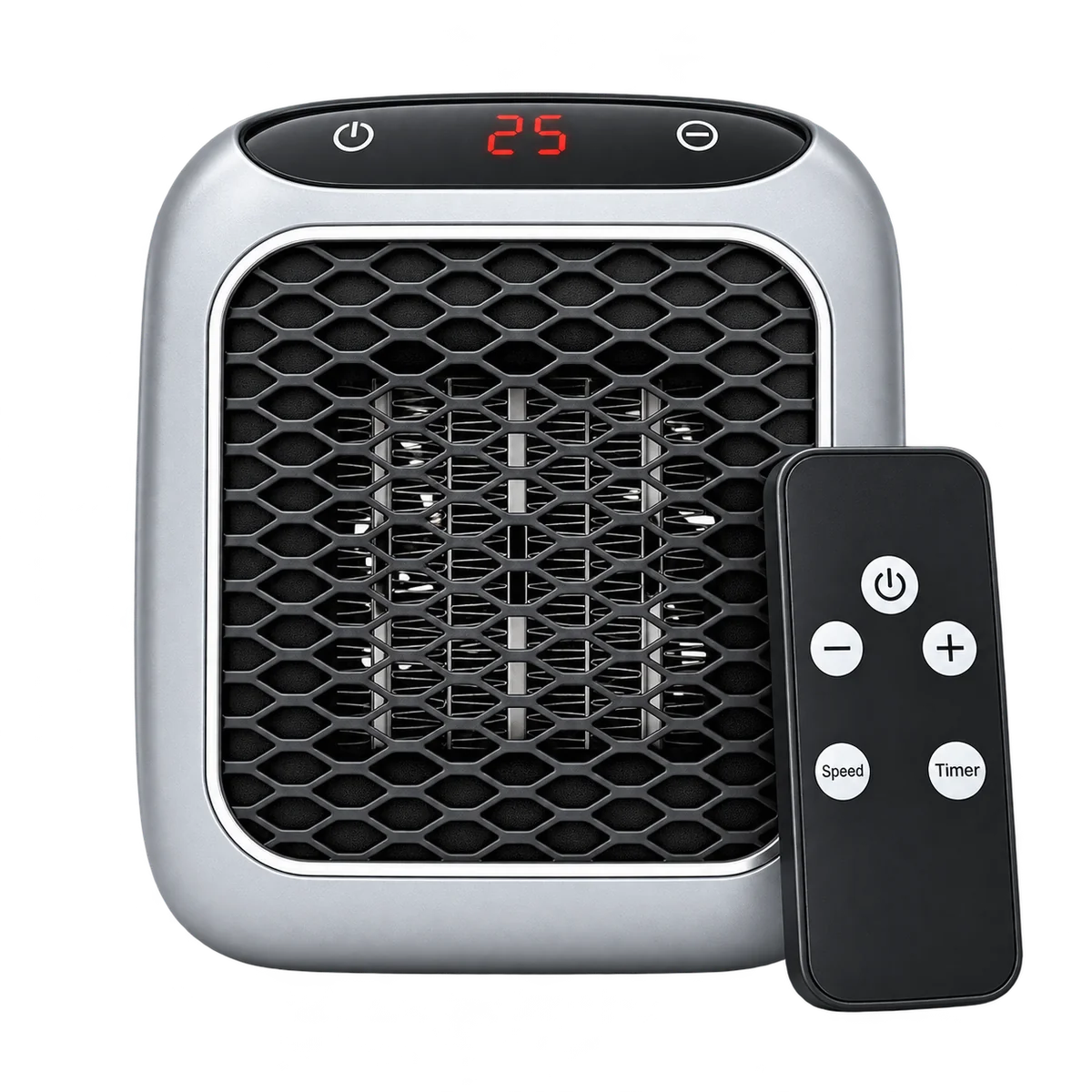
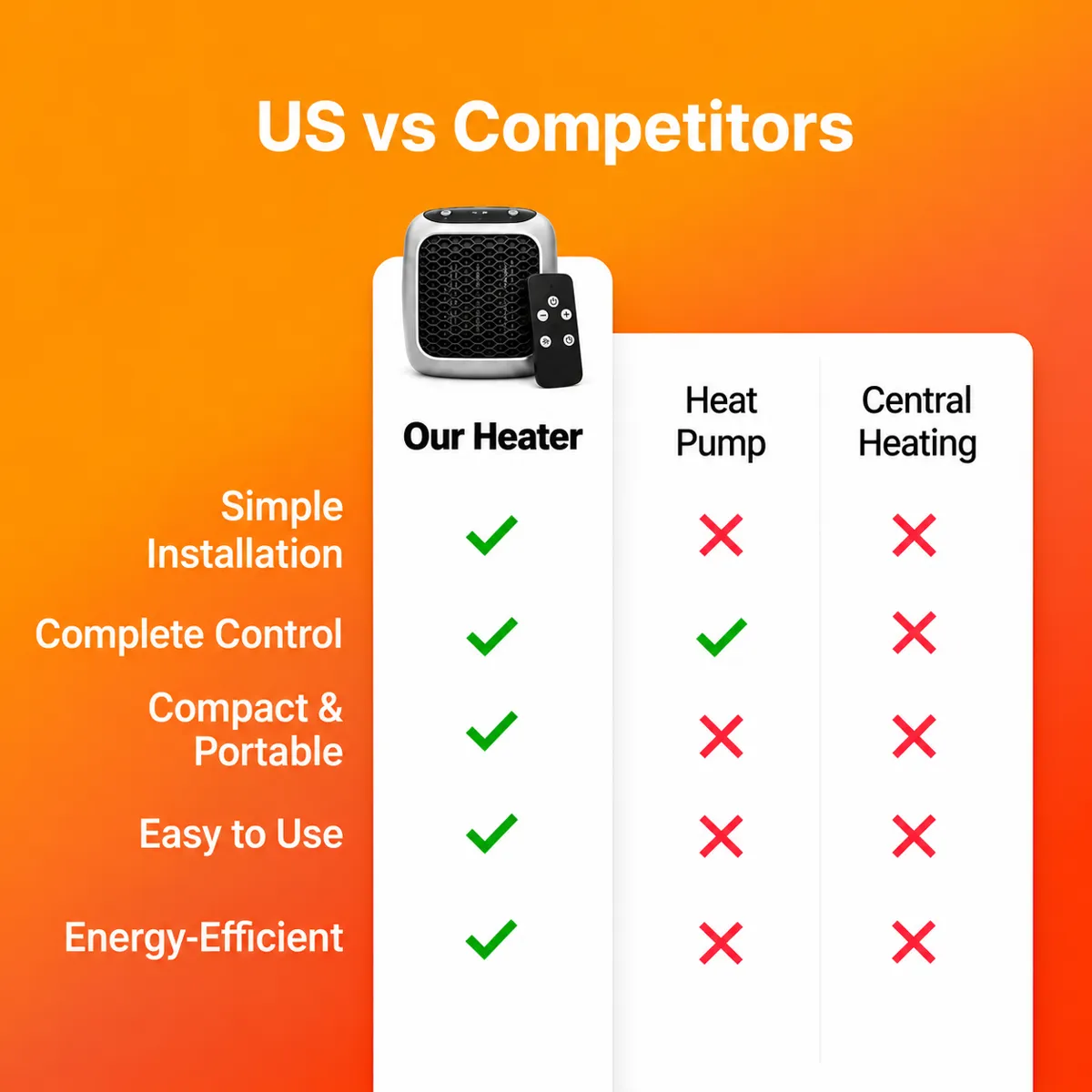
Side-by-side comparison
| Heating type | Power | Cost per hour* | Heat-up | Setup | Best for |
|---|---|---|---|---|---|
| RapidHeat (plug-in ceramic) | 400W / 800W | 0.10 / 0.20 | Seconds | None: plugs into the wall | One room up to ~250 sq ft |
| Typical space heater | 1,500W | 0.38 | Fast | None, but uses floor space | One medium room |
| Fan heater (coil) | 2,000W | 0.50 | Fast | None, uses floor space | One room; louder |
| Oil-filled radiator | 1,500W+ | 0.38+ | 20–30 min | None; heavy | One room; slow |
| Heat pump | Varies | Low per unit of heat | Minutes | Professional install, big upfront cost | Whole home |
| Central heating | Varies | Heats every room | Varies | Built into the home | Whole home |
*At full power, electricity at 0.25 per kWh, in your own currency. Thermostats lower real costs. Try your own price in the calculator.
RapidHeat vs traditional space heaters
Freestanding space heaters usually run at 1,500W or more and sit on the floor with a cable to trip over. They put out more heat, so they can warm a bigger room, but they also cost more per hour. RapidHeat plugs straight into the wall, stays off the floor and uses 400W or 800W. It's built for one bedroom, office or small living area rather than a large open-plan space.
If your room is small to medium and you mostly want to feel warm where you sit or sleep, the lower wattage is the smarter choice. If you want one heater for a big lounge, a larger heater or two RapidHeat units will do the job better.
RapidHeat vs fan heaters
Classic fan heaters use hot coils and often 2,000W. They're fast, but louder and hotter on the surface. RapidHeat also uses a fan, but with self-limiting PTC ceramic plates instead of exposed coils, running at about 45 dB. How the ceramic plates work.
RapidHeat vs oil-filled radiators
Oil-filled radiators are silent and stay warm after switching off, but take 20–30 minutes to heat up, are heavy and take up floor space. RapidHeat heats within seconds, so it suits rooms you use for a few hours at a time. Read the full ceramic vs oil-filled guide.
RapidHeat vs infrared heaters
Infrared panels warm the people and objects they face rather than the air. They're good for a spot by a desk but don't warm the whole room as evenly. Compare them in our ceramic vs infrared guide.
RapidHeat vs heat pumps
Heat pumps are very efficient for whole-home heating, but need professional installation and a large upfront investment, and aren't an option for many renters. RapidHeat costs a fraction of that, needs no installation and moves with you from room to room. Many homes with heat pumps still use a small heater for one cold room.
RapidHeat vs central heating
Central heating warms every room, including the ones nobody is using. A simple way to spend less is to turn the main thermostat down a little and use RapidHeat in the room you're in. How much you save depends on your home, your heating system and your energy prices, so we don't promise a set figure.
How many RapidHeat units match one big heater?
How many heaters for your room?
A rough guide for topping up a home that has some heating. Cold, high-ceilinged or poorly insulated rooms may need more.
| Room size | Typical room | RapidHeat units |
|---|---|---|
| Up to 250 sq ft (≈23 m²) | Bedroom, office, small living room | 1 |
| Up to 500 sq ft (≈46 m²) | Living room, large bedroom | 2 |
| Up to 750 sq ft (≈70 m²) | Open-plan or draughty room | 3 |
| Larger spaces | Alongside your main heating | 4 |
When RapidHeat is the right choice
- You want quick warmth in a bedroom, office, nursery or small living area
- You rent or can't install fixed heating
- You want to stop heating the whole house to stay warm in one room
- You want something quiet that takes no floor space
When it isn't
- You need to heat a large, poorly insulated space with a single heater
- You want to heat a whole home without central heating
- You need a heater for wet areas or outdoors
For bigger rooms, several units in different outlets work well, and our bundles lower the price per heater.
Common questions
Is RapidHeat better than a regular space heater?
For small rooms, yes: it uses less power (400W/800W vs 1,500W+), takes no floor space and has a thermostat, remote and timer. For large rooms, a bigger heater or several RapidHeat units are better.
Is it better than an oil-filled radiator?
It's faster and far more compact. Oil-filled radiators are quieter and suit long, steady heating.
How much does RapidHeat cost to run?
At full power it uses 0.4 kWh per hour on Low (400W) and 0.8 kWh per hour on High (800W). Multiply by your price per kWh; at 0.25 that's 0.10 or 0.20 per hour. The thermostat often brings real use lower.
What size room does one RapidHeat heat?
Up to about 250 sq ft (≈23 m²). For bigger or draughty rooms, use two or more units on different walls.
Is there a guarantee?
Yes. Orders from the official store come with a 30-day money-back guarantee.
Is RapidHeat cheaper to run than a 1,500W space heater?
Per hour at full power, yes: 400W or 800W uses less electricity than 1,500W. But a smaller heater warms a smaller space, so match the heater to your room.
Can RapidHeat replace central heating?
Not for a whole house. It works best alongside central heating: turn the main thermostat down and warm just the room you're in.
Is RapidHeat better than an oil-filled radiator?
It heats up much faster and takes no floor space. Oil-filled radiators are silent and hold heat longer, but they're slow and heavy.